
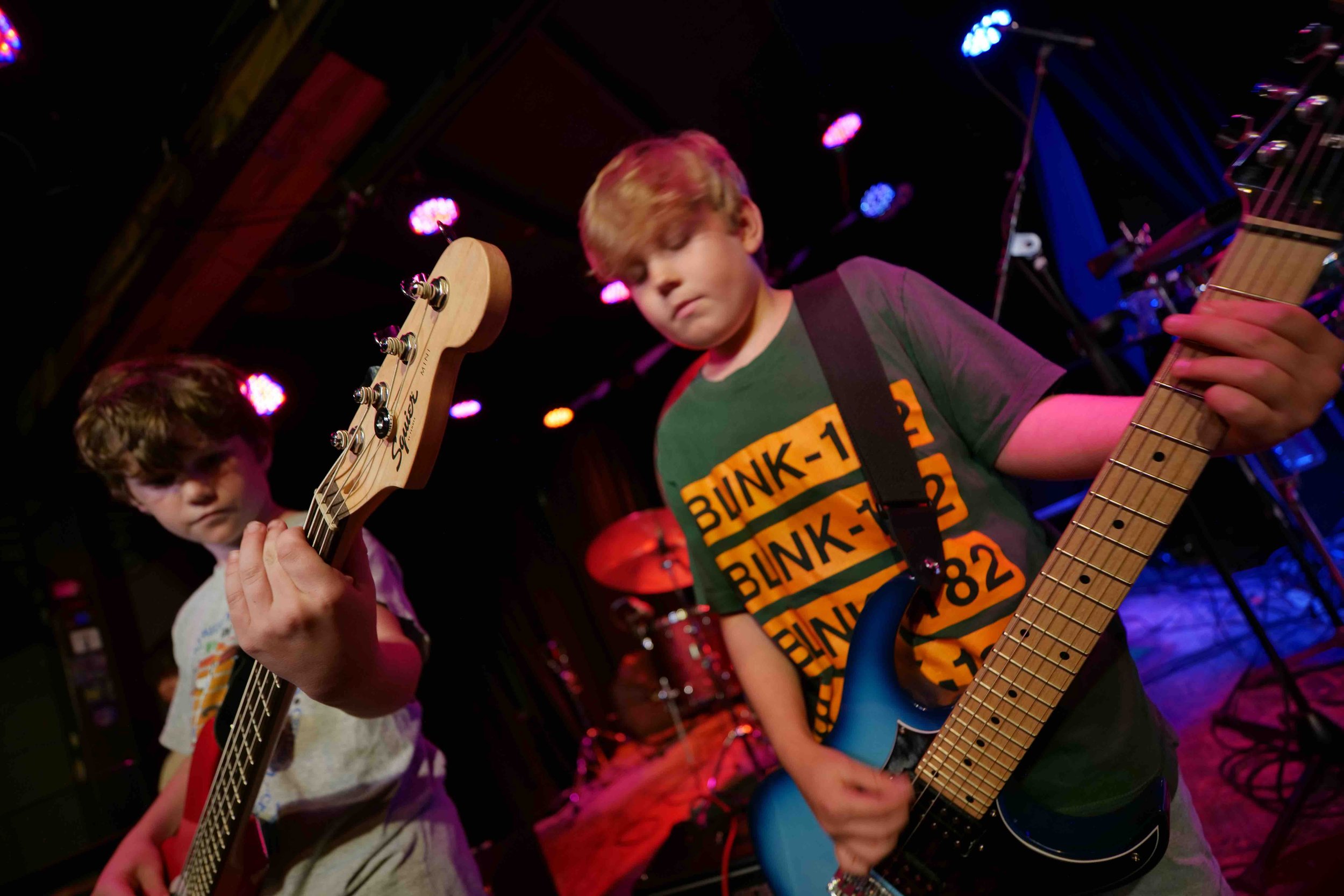
GUITAR LESSONS
“The (Ghost) Note has highly dedicated teachers who make lessons fun, foster a love for music, and take their students to the next level.”
ELECTRIC & ACOUSTIC GUITAR LESSONS
We have had the privilege of helping countless creatives in the Denton, TX area discover self-expression through music since 2012.
All ages, levels, and grooves welcome!
Enroll in private weekly 30- or 60-minute lessons, billed monthly, and start building real skills from day one.
We work weekly with guitar students of all ages and experience levels, specializing in:
• all styles for beginners & serious hobbyists
• Junior high & high school jazz band
• Advanced players, sharpening their craft for auditions, bands, and beyond
🔥 From Beginner to Pro!
Many of our students have gone from total beginners to professional players over the course of their studies with us. Some started as young as 5 and now drive themselves to lessons.
🎯 100% Customized Lessons
Every student is different—and so is every lesson. We tailor instruction to each student’s goals, interests, and musical needs, while covering the essential foundations that make great musicians.
🎓 Middle School Jazz Band? We’ve got you covered.
We help students start early in elementary school — before entering 6th-grade band — get a massive head start by teaching them guitar in all styles, so they hit the ground running from day one and stay ahead of their peers. We also encourage students to find other musicians at school to hang and jam with.
🏆 Proven Results
We’ve worked weekly with students in grades K–12, helping them earn top rankings in:
• UIL
• Solo & Ensemble
• Region, Area & State Band
• Jazz band & college auditions
📚 Exclusive Learning Resources
All students get access to an ever-growing library of professionally notated transcriptions of common lessons and songs.
Plus, we create custom play-along tracks where we remove the drum part, so you can practice being the drummer in the band.
👨🏫 TEACHERS
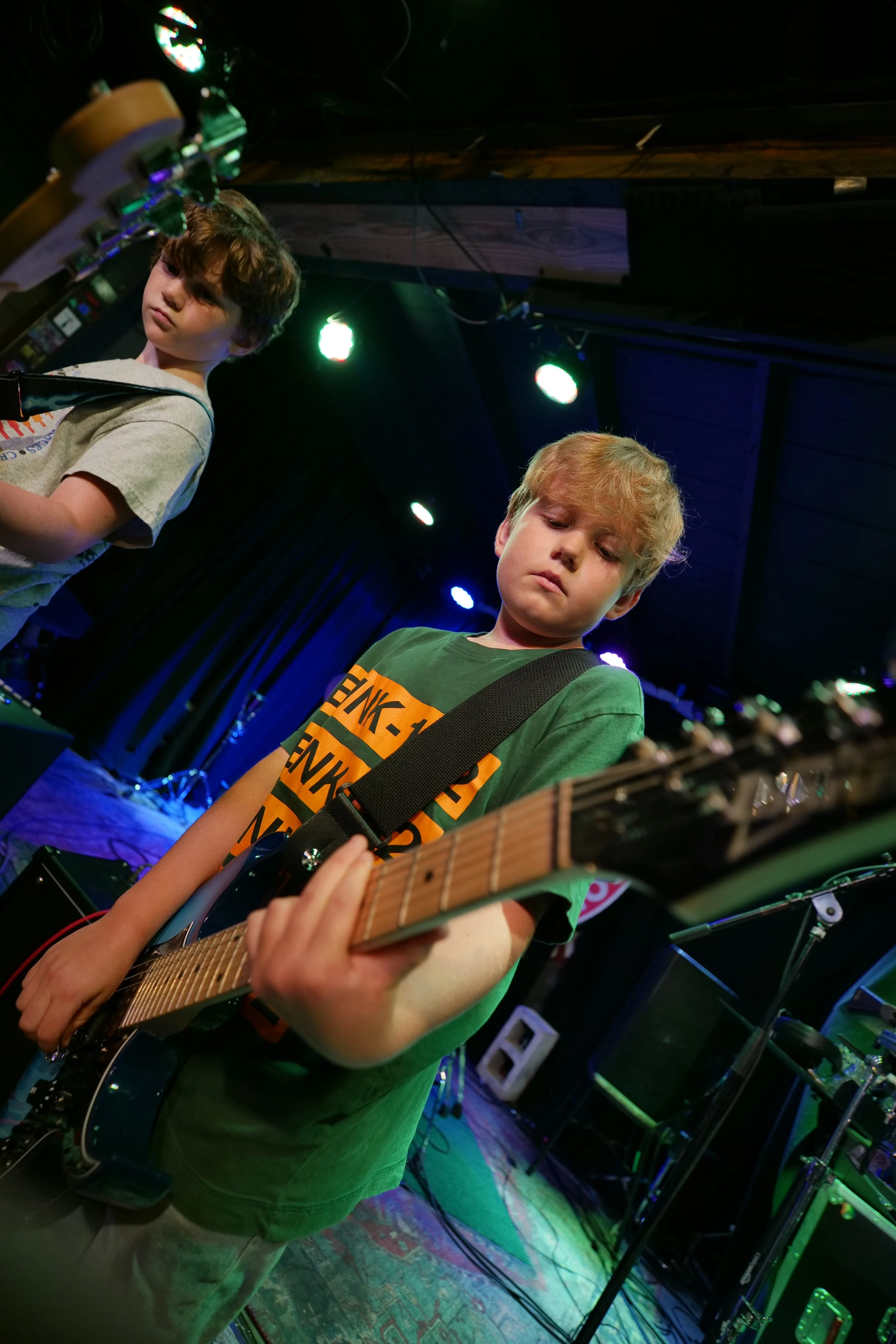
We staff only the most skilled teachers to work with students of all ages and levels on guitar—our teachers teach only their primary instrument. The current guitar teaching roster is Pedro Areco, Sean Torres, and Alex Hand.


GUITAR FAQ
GENERAL
-
Most children can start around ages 6–7, once they can comfortably hold the instrument and press the strings. Younger students may do better with shorter lessons or a smaller guitar.
-
No! The idea that you can’t learn as you get older is false! In fact, an activity such as drumming, which requires your full focus and engages your nervous system, will increase your ability to learn.
Playing guitar at any level of ability is a blast and highly encouraged!
-
Yes. You will need your own instrument to play at home and bring to lessons. You can start with either an acoustic or an electric. For most beginners, an acoustic guitar is the best option to start with, as it is affordable, doesn’t require electricity or an amp, and, most importantly, will help you learn to create a good sound.
If you aren’t sure what to purchase, we can help you make a decision.
-
Ultimately most guitar players end up owning botha nacoustic and electric guitar.
An acoustic guitar is the most affordable option because you only need to buy a guitar vs an electric where you need an amp and cables.
Each version has it benefits. Acoustic guitar is an excellent option to start on because it is affordable, doesn't require electricity to play, and helps you learn to create a good tone from the start.
-
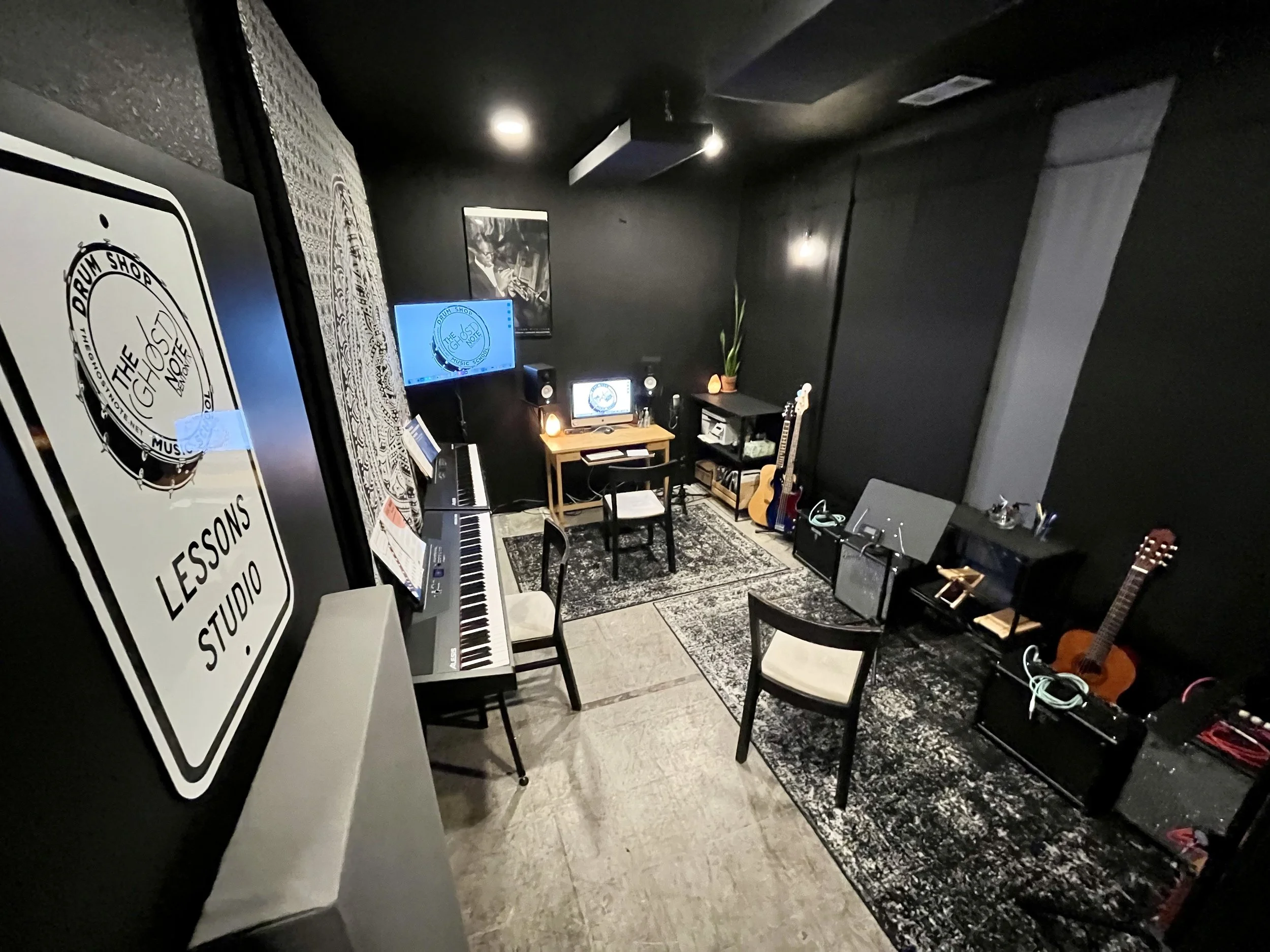
Our lessons studios are fully equipped with multiple guitar amps, cables, music stands, and anything needed to support guitar playing. All you need to bring is your guitar, picks, tuner, and notebook.
-
As you can guess, learning an instrument is a lifelong endeavor; everyone learns at different paces and works towards different goals. The main goal is to enjoy the process of learning and making music, regardless of experience level. We aim to help students fall in love with the process of learning their chosen instrument, fostering a lifelong relationship with music.
With guitar, the most challenging hurdle is navigating the fretboard. We look forward to helping you unlock the mysteries of guitar and get you making music!
-
Learning to play music has as many meanings as there are people who play it.
We encourage everyone to meet themselves on the musical map where they are at.
Some students are very casual and enjoy playing just apocuple times a week, some students are weekend warriors, ssome students play every day for 20-60 minutes casually while others obsess every hour of the day about music and learning. Every one of these students plays the “correct” amount because they are find ways to fit music into their life in a natural way.
Some of our students play only a few times a week, while others play multiple hours a day. The main goal is to play as time allows and enjoy the act of making music and pursuing improvement.
-
Yes and no. You could play your whole life note reading one note of music, but your musical life might be uch more difficult not being able to read and navigate through music on your own.
Reading music is actually easier than most people expect, and only helps you to learn. We incorporate both reading and playing by ear in lessons, as we believe they are of equal importance.
-
We enroll by the month for 30 or 60-minute weekly lessons on a recurring day/time.
To ensure each student gets their full lesson, we schedule students with a 5-minute break, allowing them time to work until the very end of the lesson and then pack up, allowing teachers to greet the next student before the lesson starts.
-
Yes. Your teacher will keep both physical and digital lesson notes each week. All of your notes are available online in the student portal.
-
Please complete our new student enrollment form, and we will contact you for an enrollment consultation and to schedule your lessons.
AREAS OF STUDY
-
all styles, ages, and levels of experience
standard acoustic guitar
classical guitar
electric guitar
-
Instruction includes exposure to a comprehensive range of genres:
Classical, jazz, and contemporary art music
Pop, rock, hip-hop, EDM
Country, blues, folk, R&B/soul
Sub-genres and cross-cultural rhythmic traditions
-
1. Rhythm & Time
Music begins with rhythm. Students learn to:
Keep a steady beat
Count and subdivide rhythms
Understand time signatures and tempo
Strong rhythm skills are essential for ensemble playing and solo performance.
2. Pitch Accuracy
Technical development includes:
Playing or singing in tune
Understanding high vs. low pitch
Matching pitch by ear
This builds confidence and musical control.
3. Reading Music Notation
Students learn to interpret:
Notes and rests
Rhythmic values
Dynamics and articulations
Musical symbols and markings
Reading allows students to learn new music independently.
4. Technique & Physical Coordination
Each instrument requires physical skills:
Proper posture and alignment
Efficient hand, finger, or breath control
Coordination between limbs or voice and body
Good technique prevents injury and improves sound quality.
5. Tone Production
Students learn how sound is created:
Producing a clear, consistent tone
Controlling volume and quality
Understanding how technique affects sound
Tone is a foundational technical skill on every instrument.
6. Ear Training & Listening Skills
Musicians develop the ability to:
Hear mistakes and correct them
Recognize intervals, chords, and rhythms
Balance their sound with others
Listening is as important as playing.
7. Dynamics & Expression
Technical control allows musicians to shape music:
Playing loud and soft
Accents and articulation
Musical phrasing and expression
This transforms notes into music.
8. Coordination & Independence
Students develop:
Hand-to-hand or voice-to-instrument coordination
Independence between limbs or musical lines
Multitasking skills while performing
This is especially important for piano, drums, and ensemble instruments.
9. Tempo Control & Practice with a Metronome
Musicians learn to:
Maintain consistent tempo
Speed up or slow down intentionally
Practice effectively with a metronome
Tempo control is essential for professional-level playing.
10. Scales, Patterns & Technical Exercises
Technical fluency is built through:
Scales and arpeggios
Pattern recognition
Repetitive technical exercises
These improve accuracy, speed, and muscle memory.
11. Practice Technique
Learning music includes learning how to practice:
Breaking music into sections
Slow, focused repetition
Goal-oriented practice sessions
Good practice habits accelerate progress.
12. Musical Memory
Students develop:
Muscle memory
Visual and aural memory
Confidence performing without relying solely on sheet music
13. Ensemble & Collaboration Skills
Technical musicianship includes:
Playing in time with others
Listening and adjusting
Following a conductor or bandleader
These skills are critical for bands, orchestras, and groups.
14. Style-Specific Techniques
Different genres require different skills:
Classical precision
Jazz swing and harmony
Rock and pop groove
Improvisation and feel
Students learn to adapt technique to style.
Why Technical Skills Matter
Strong technical foundations allow students to:
Learn music faster
Avoid bad habits or injury
Play confidently and musically
Progress from beginner to advanced levels
-
Fretting-Hand Technique
How your non-picking hand interacts with the fretboard.
Finger placement – close to the fret, correct pressure
Hand position – thumb placement, wrist angle
Finger independence – ability to move fingers separately
Shifting & position changes – moving smoothly up/down the neck
Barre technique – consistent pressure across strings
Stretching – wide intervals without tension
Picking / Strumming Technique
How you strike the strings.
Picking Hand
Alternate picking (down/up strokes)
Economy picking
Fingerstyle technique
Hybrid picking
Palm muting
Pick grip and angle
Strumming
Rhythmic accuracy
Dynamic control (soft vs aggressive)
String targeting (avoiding unwanted strings)
Timing & Rhythm Control
Often, the most overlooked technical skill.
Playing in time with a metronome
Subdivision awareness (quarters, eighths, triplets, sixteenths)
Groove consistency
Syncopation accuracy
Left–Right Hand Synchronization
Both hands working together cleanly.
Clean note starts and stops
Avoiding ghost notes and string noise
Fast passages without tension
Scale and arpeggio accuracy
Articulation Techniques
How notes are connected or shaped.
Hammer-ons & pull-offs
Slides
Bends (pitch accuracy is critical)
Vibrato (speed and width control)
Legato vs staccato playing
Muting & Noise Control
Crucial for clean playing, especially with amplification.
Left-hand muting unused strings
Right-hand palm and thumb muting
Controlling string resonance
Clean transitions between chords or notes
Chord Technique
Physical execution of chords.
Open chords
Barre chords
Power chords
Partial chords and triads
Smooth chord changes
Clean voicing without buzz
Tone & Touch Control
How technique affects sound.
Pick attack
Finger pressure
Consistency across strings
Dynamic control
Tone changes without touching amp settings
Endurance & Injury Prevention
Often ignored but essential long-term.
Relaxed posture
Tension management
Efficient motion
Building stamina gradually
Avoiding repetitive strain injuries
Instrument-Specific Technique
Depends on style and goals.
Electric guitar: muting, bending, sustain control
Acoustic guitar: attack balance, projection
Classical guitar: nail technique, rest/free strokes
-
Timekeeping, feel, sound production
Brush techniques in multiple styles
Ensemble interaction and musical decision-making
-
practice psychology
focus management
performance mindset
growth-oriented learning strategies
-
how to approach different styles of music
rhythmic theory
scales and chords
improvising
phrase structure and song form
-
Good practice isn’t about playing longer; it’s about practicing smarter and more consistently. Short, focused sessions lead to faster progress and less frustration.
Good practice builds:
Confidence
Discipline
Musical growth
Lifelong learning habits
With guidance and consistency, students see progress quickly—and enjoy the process.
Some topics covered:
Efficient, measurable practice routines
Sensory-based learning: hearing and seeing improvement using audio production equipment.
Alternatives to metronome-based practice
How much should I practice each week?
Beginners: 15–20 minutes, 4–5 days/week
Intermediate: 30–45 minutes/day
Advanced: 60+ minutes/day
Obsessed: multiple hours a day, playing is as common as eating, dreams in music, music is their life purpose.